E-2 Visa for Canadians: Requirements, Investment & Toronto Process


Canada is the top E-2 visa-issuing country in the Americas. In FY2025, 6,779 Canadian citizens received E-2 visas, more than any other Western Hemisphere nationality. This guide covers who qualifies, how much you need to invest, how the Toronto consulate process works, and why franchise-based investments consistently produce strong E-2 outcomes for Canadian applicants.
Canada is an E-2 treaty country under CUSMA (the Canada-United States-Mexico Agreement), meaning Canadian citizens are fully eligible to apply for a US E-2 investor visa. Unlike many nationalities, Canadians process the E-2 directly at a US consulate in Canada, no USCIS petition required. This guide explains who qualifies, how much you need to invest, and why buying a US franchise is one of the most straightforward paths to E-2 approval.
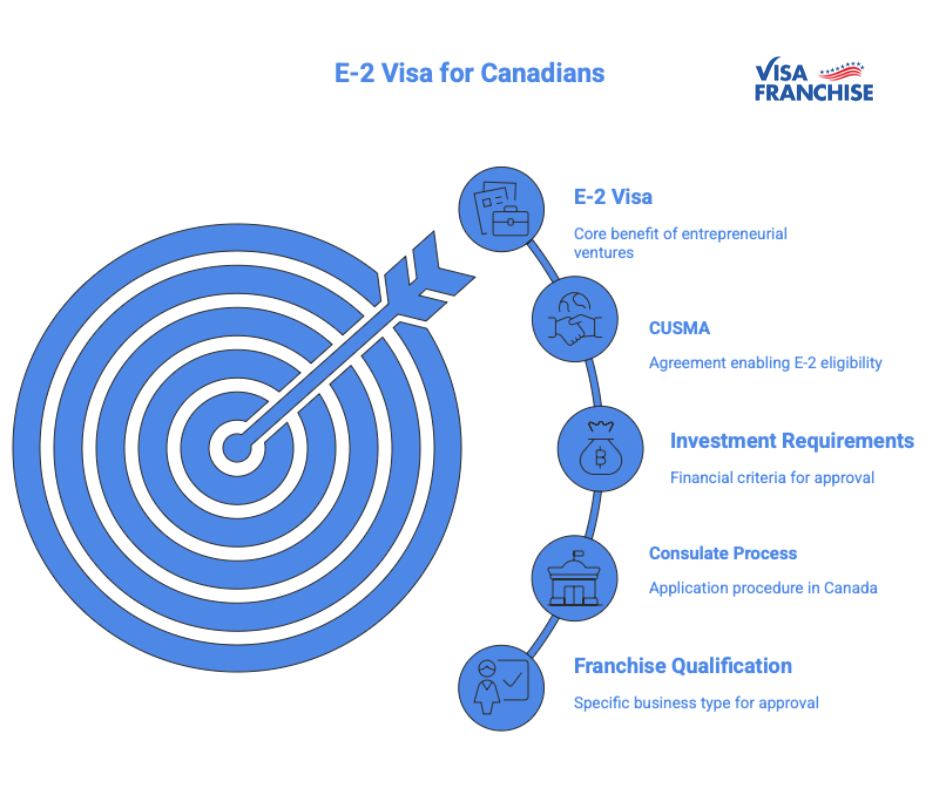
The E-2 investor visa presents an opportunity for Canadian nationals to embark on entrepreneurial ventures in the United States. This visa category offers distinct advantages, setting it apart from alternatives like the EB-5 investment visa.
Can Canadians get an E-2 visa?
Yes. Canada qualifies under CUSMA (the Canada-United States-Mexico Agreement), which replaced NAFTA on July 1, 2020 and preserved the bilateral investment treaty provisions unchanged. Canadian investors have held continuous E-2 access since January 1, 1994. The treaty is not subject to annual reauthorization, which gives Canadian applicants a stable legal foundation that some other nationalities lack.
Unlike most E-2 nationalities, Canadians do not file a petition with USCIS before going to a consulate. The application is processed directly at the U.S. Consulate in Toronto, which shortens the overall timeline considerably.
E-2 visa requirements for Canadian citizens
1. Canadian citizenship
The applicant must be a Canadian national. Permanent residents of Canada who are not Canadian citizens do not qualify under CUSMA and cannot use the E-2 investor pathway.
2. Substantial investment
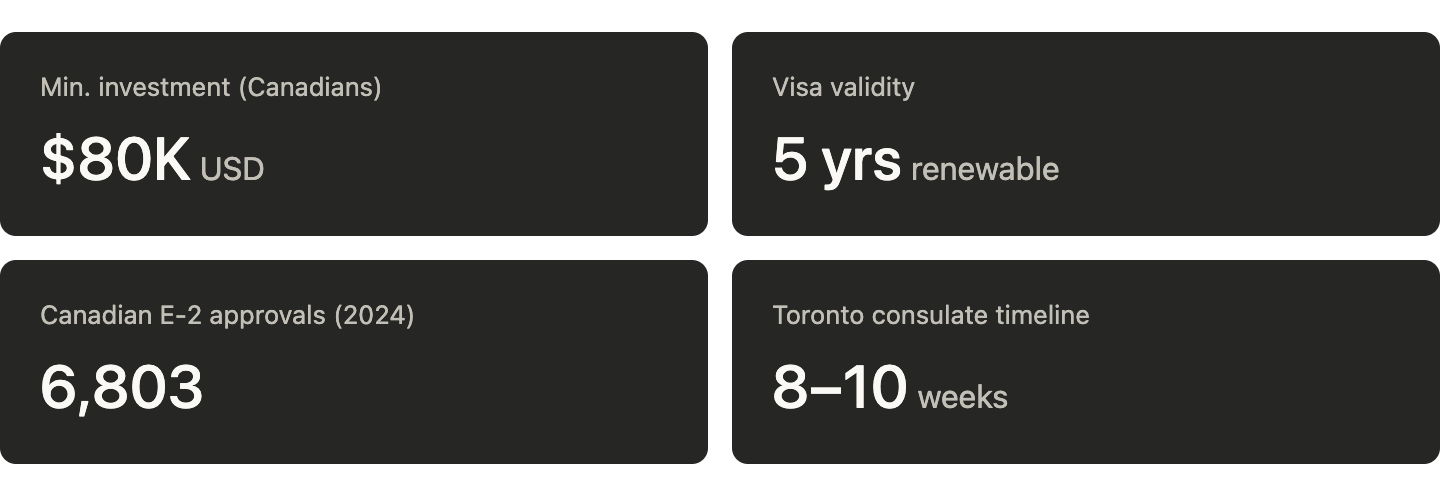
The U.S. government does not set a fixed minimum dollar amount, but the investment must be substantial relative to the total cost of the enterprise. In practice, most successful Canadian E-2 applications involve at least $80,000. For other E-2 nationalities, $100,000 is the more common practical benchmark.
USCIS applies a proportionality test. For lower-cost businesses such as service-based or home-based operations, a higher percentage of the total business cost must be invested. For higher-cost businesses such as manufacturing or retail, a smaller percentage may satisfy the substantial investment standard. Funds must be irrevocably committed and at risk. Capital sitting in a reserve account does not count toward the threshold.
3. Real Operating Enterprise
The investment must fund a genuine, active enterprise that produces goods or services for profit. Additionally, the business must be non-marginal, generating ample revenue to cover operational costs and provide a reasonable living for the investor.
4. What is the investor’s role in the enterprise
Canadian investors must actively develop and direct the commercial enterprise or business they are investing in. In cases where the investor is not the principal, supervisory, highly skilled, or executive positions may qualify, but the business itself must meet E-2 investment requirements.
5. Choosing a business model
Prospective Canadian E-2 visa holders have various avenues to explore. They can opt to invest in a franchise, collaborate with a partner in an established enterprise, or build a new business. Each approach offers unique advantages and considerations.
How much does the E-2 visa cost for Canadians?
Beyond the investment itself, applicants should budget for three categories of costs.
The U.S. government charges a $205 nonimmigrant visa application fee (MRV fee) per applicant. Spouses and children applying as dependents each pay the same fee.
Legal fees for a qualified immigration attorney handling the full E-2 application typically run between $5,000 and $12,000 depending on complexity, the attorney's firm, and whether the investment structure requires additional documentation. This is separate from the business investment.
The business investment itself varies by type. A franchise investment, including the franchise fee, equipment, leasehold improvements, and working capital, commonly falls between $80,000 and $200,000 for service-sector concepts. Retail and food-service concepts typically run higher.
How to apply: the Canadian consulate process
Where do Canadians apply for the E-2 Visa?
All new E-2 investor applications from Canadian citizens are processed exclusively at the U.S. Consulate in Toronto. The consulates in Calgary, Montreal, Ottawa, and Vancouver do not conduct new E-2 investor interviews, they handle only renewals and applications from dependents and employees of registered E-visa companies. Even if you live in British Columbia or Alberta, you must travel to Toronto for your initial investor interview.
The U.S. Consulate in Toronto enforces a strict 70-page document limit for E-2 applications. This is more restrictive than consulates in most other countries and requires careful document selection and editing.
Policy update: The U.S. Department of State issued guidance on September 6, 2025, advising all visa applicants, including those currently residing in the United States, to submit applications in their country of residence or nationality. Canadians currently in the U.S. on another visa status should confirm with a qualified immigration attorney whether this guidance affects their filing options before proceeding.
Can Canadians apply for the E-2 Visa without leaving the United States?
Canadians already present in the U.S. on valid nonimmigrant status such as a visitor visa, B-1/B-2, or TN may be eligible to change their status to E-2. By filing Form I-129 (Petition for Nonimmigrant Worker) with USCIS, they may be able to avoid returning to Canada for a consulate interview. This is known as a change of status rather than a consular application.
However, a change of status does not produce a visa stamp in your passport. The first time you depart and re-enter the U.S. after a change of status, you will need to apply for a physical E-2 visa stamp at the U.S. Consulate in Toronto before being readmitted in E-2 status.
How long does it take for Canadians to get the E-2 Visa?
Former U.S. Consulate Staffer and Visa Franchise team member, Thiago Babesco, said, “it's taking about 6 weeks for the [Toronto consulate] to review the case and then about 2 weeks for scheduling an appointment,” leading to a conservative estimate of 8-10 weeks total.
Visa validity and renewal
E-2 Visas for Canadian citizens are typically granted with a validity of up to five years. Holders can enter and exit the U.S. as often as they wish during this period. Upon each entry, the investor and family members are admitted in E-2 status for two years, allowing for extended stays in the United States.
The investor and accompanying family members can simply travel abroad during the visa’s validity period to restart the 2-year status. This process enables seamless continuation of business activities in the U.S. After the five-year period investors can indefinitely renew the visa if the business still meets the E-2 requirements.
How does the E-2 compare to other visa options for Canadians?
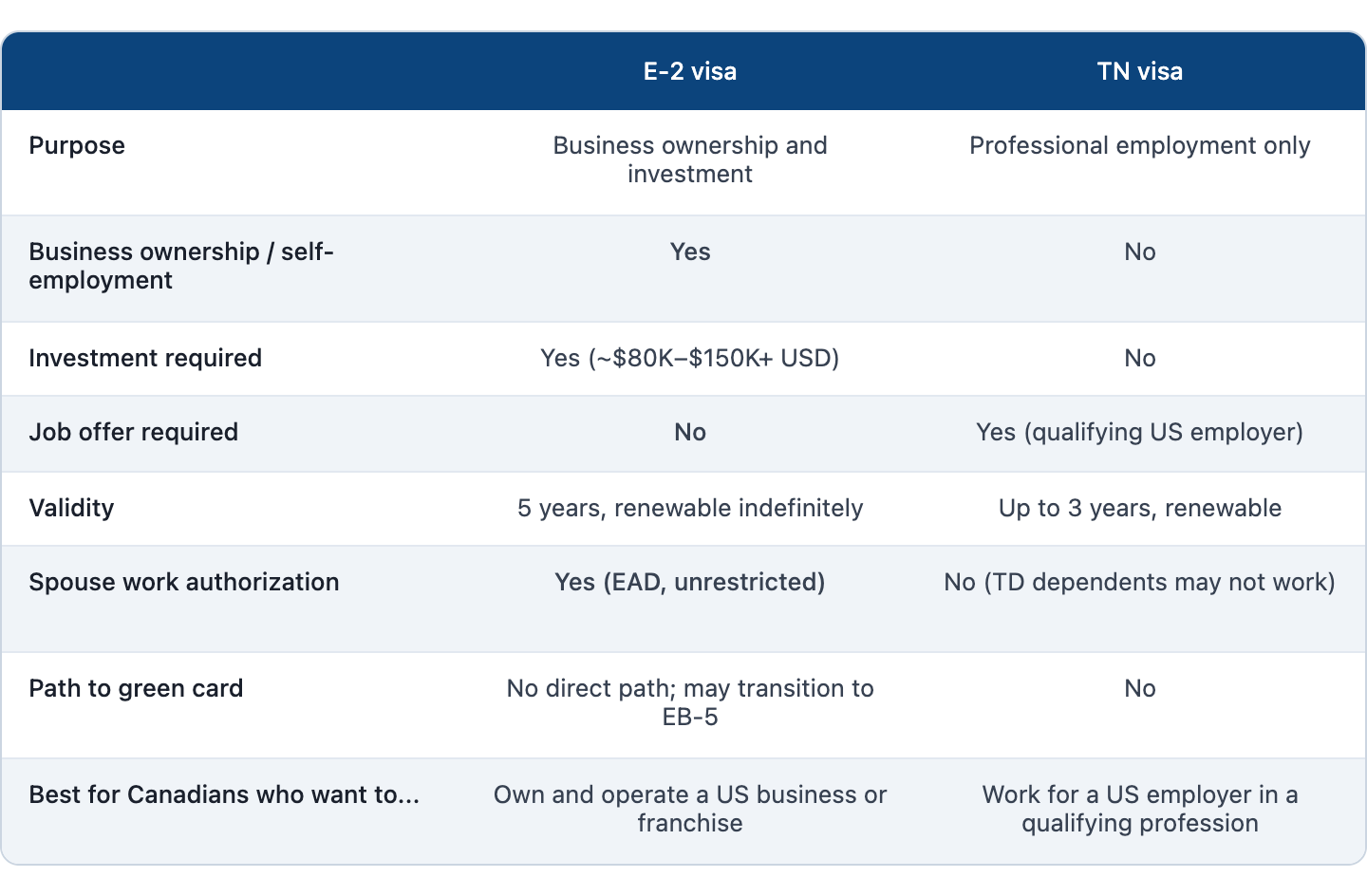
Not every U.S. visa path is available to business owners. The table below compares the most relevant options for Canadian entrepreneurs and investors.

E-2 vs. TN visa: which is better for Canadians?
Both the E-2 and TN visas are available to Canadian citizens under USMCA, but they serve fundamentally different purposes. The TN visa is for salaried professionals in qualifying occupations (such as engineers, accountants, and scientists) who have a job offer from a US employer. Self-employment and business ownership are not permitted under TN status.
The E-2 visa, by contrast, is specifically designed for investors who own and operate a US business. Canadians who want to buy a US franchise or launch a business do not qualify for the TN Visa. The E-2 is the primary nonimmigrant route available.
Why a US Franchise is ideal for E-2 approval
Franchises are among the most E-2-compatible businesses available to Canadian investors. Our Franchise Visa Program™ takes advantage of this reliable structure. The US immigration system requires that an E-2 investment funds a genuine, active, and non-marginal enterprise. The conditions established by franchise brands are uniquely positioned to satisfy those requirements. Therefore, our Franchise Visa Program™ takes advantage of this reliable structure and has consistently strong E-2 application outcomes due to:
- The FDD as application evidence: Every US franchisor is legally required to provide a Franchise Disclosure Document (FDD) before any sale. The FDD documents the business model, financial performance representations, training and support systems, and the franchisor’s track record. Immigration officers routinely accept the FDD as primary evidence that the investment is in a legitimate, structured, and commercially viable enterprise.
- Proven operating model: A franchise is a replicable business with a documented revenue history across multiple locations. This directly supports the E-2 requirement that the enterprise be non-marginal, capable of generating income beyond the investor’s personal, and providing jobs or economic benefit in the United States.
- Operations manual: Franchise systems provide a detailed operations manual covering staffing, quality control, supplier relationships, and day-to-day procedures. This documentation makes it straightforward to demonstrate that the business is real, active, and operational from day one, standalone business plans often struggle to satisfy as convincingly for the E-2.
- Established brand and support infrastructure: Franchisor training programs, marketing systems, and supplier networks reduce execution risk. This also makes it easier to demonstrate to a consular officer that the business is a viable, going concern over a speculative investment. This distinction matters in the E-2 adjudication process.
- Visa Franchise’s role: Visa Franchise specializes in matching Canadian investors with US franchise opportunities that meet E-2 investment thresholds and align with their personal and financial goals by utilizing our sister company, Vetted Biz: the largest franchise database in the U.S.. From shortlisting franchise concepts to organizing the application documentation, the process is designed to move efficiently from investment decision to visa approval.
Benefits of the E-2 visa for Canadian investors
The E-2 visa offers several advantages that are particularly relevant to Canadians making the move to the U.S.:
- Spouse work authorization: Spouses of E-2 visa holders are eligible to apply for an Employment Authorization Document (EAD), allowing them to work for any U.S. employer without restriction.
- Children’s education: Unmarried children under 21 may accompany the principal applicant and attend school in the United States.
- No quota: Unlike many visa categories, the E-2 has no annual cap, there is no waiting period caused by oversubscription.
- Unlimited renewals: The visa can be renewed indefinitely as long as the business remains active and continues to meet E-2 requirements.
- Free travel: E-2 holders can travel freely in and out of the U.S. throughout the visa validity period.
A note on Canadian taxes:
One financially significant benefit for Canadian E-2 investors is the potential to achieve CRA non-resident status. If you sell your primary Canadian residence and relocate to the U.S. full-time under E-2 status, you may qualify as a non-resident of Canada for tax purposes which can eliminate Canadian income tax obligations on U.S.-earned income. This is not automatic and has specific conditions; consult a cross-border tax accountant before making any decisions based on this possibility.
Frequently asked questions: E-2 visa for Canadians
Can a Canadian citizen get an E-2 visa?
Yes. Canada is an E-2 treaty country under CUSMA (Canada-United States-Mexico Agreement), so Canadian citizens are fully eligible to apply for a US E-2 investor visa at a US consulate located in Canada.
How much do you need to invest for a Canadian E-2 visa?
There is no fixed minimum, but the investment must be 'substantial' relative to the total cost of the enterprise. In practice, most successful E-2 applications involve a minimum of $80,000. For franchise buyers, the combination of the franchise fee, equipment, and startup costs typically meets this threshold.
Where do Canadians apply for the E-2 visa?
All new E-2 investor applications from Canadian citizens are processed exclusively at the U.S. Consulate in Toronto. This is the only Canadian consulate authorized to conduct new E-2 investor interviews. Renewals and dependent applications may be handled at other Canadian consulates, including Calgary, Montreal, Ottawa, and Vancouver.
How long is the E-2 visa valid for Canadians?
The E-2 visa is typically issued for 5 years to Canadian citizens and is renewable indefinitely, provided the business remains operational and the investor continues to meet the visa requirements.
What is the success rate of the E-2 visa from Canada?
Canada's E-2 approval rate is among the highest of any nationality. Visa Franchise's Canadian client approval rate exceeds 95%. Well-prepared applications with a qualifying investment, a clear business plan, and properly documented source of funds are approved at high rates at the Toronto consulate.
Can a Canadian E-2 visa holder apply for a green card?
The E-2 visa does not directly lead to permanent residency. However, E-2 holders may transition to EB-5 (investor green card) if their business grows to meet that program's thresholds or explore other immigrant visa pathways over time.
Discover if you qualify to invest in a thriving U.S. franchise and secure your E-2 visa.
Check your eligibility
More Insights You Might Like
Explore related articles packed with expert advice, real stories, and practical tips to support your U.S. visa and relocation journey.