
E-2 visa business plan: requirements, cost & writers (2027)

A business plan for an E-2 visa explains your U.S. business to the consular or USCIS officer, demonstrating a committed investment, a genuine business, and potential for growth.
An E-2 case is about more than just the investment. The officer also wants to understand the business behind it, including what products or services it will offer, how many employees it will hire, and how it will grow over the next few years. For most applicants, especially those starting a new business, the business plan tells this story, and every figure in it must match the rest of the application.
What is an E-2 visa business plan and who reviews it?
A business plan for an E-2 visa is the document that explains your U.S. business to the officer deciding your case. It should detail what the company does, how your investment is being used, and how the business is expected to grow over its first five years. For a new business, it is usually the main piece of evidence that an officer uses to judge whether the company can become more than just a means of supporting you and your family.
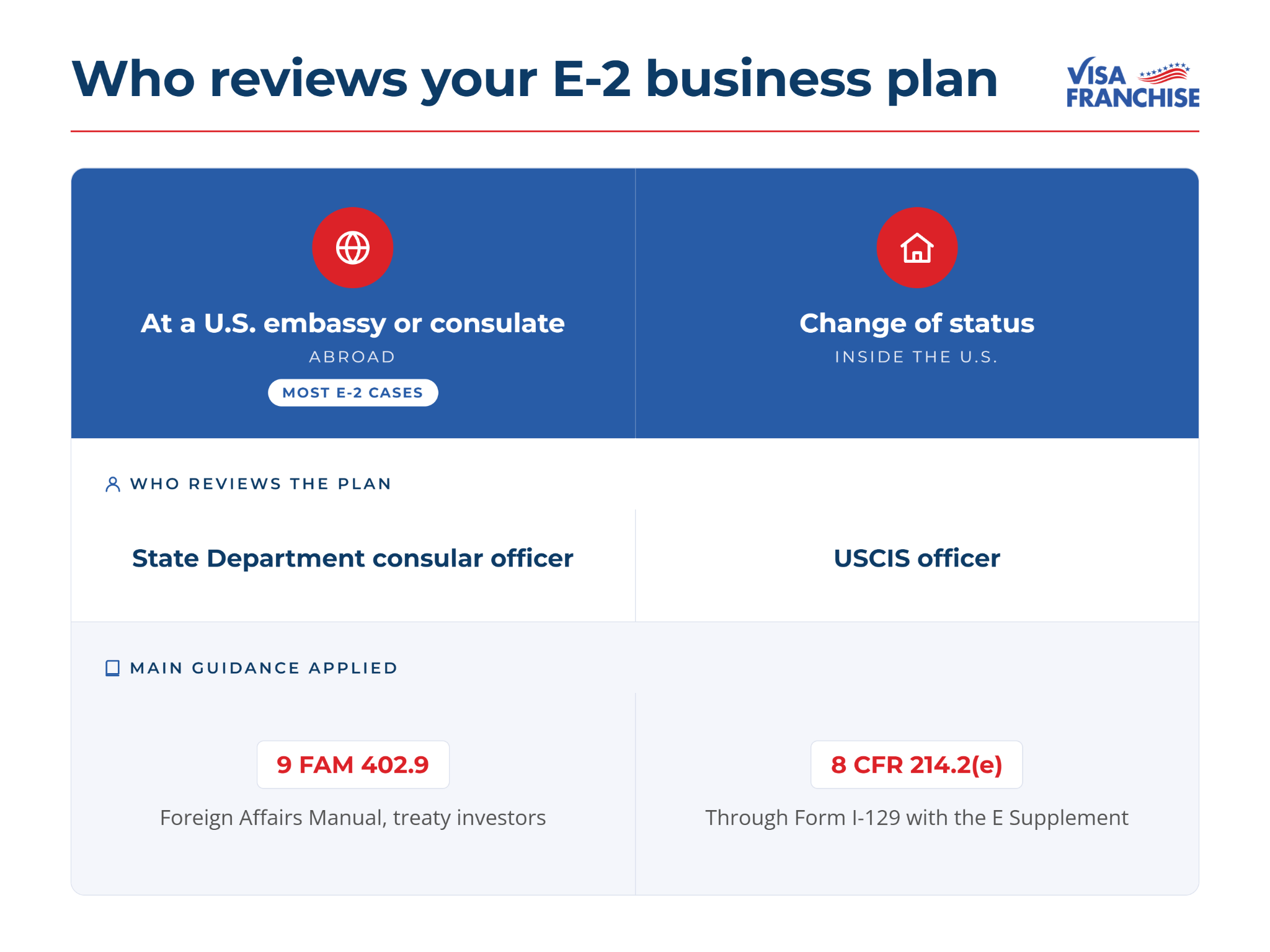
It is not a government form, and neither the State Department nor USCIS publishes an official template. Who reads it depends on where the case is filed:
Officers on both sides also tend to measure a plan against the 'Matter of Ho' decision (issued in 1998 for the EB-5 investor visa), which is widely used as the benchmark for a credible immigration business plan. This should be detailed and include realistic financial projections, a hiring timeline, and evidence that the business is actually being set up and not just described.
However, each consulate can add its own document checklist and formatting instructions, so it is advisable to consult an independent immigration attorney to confirm what your plan needs to cover for your case. To see how the consular and change-of-status processes work, see our E-2 visa guide.
What must an E-2 business plan prove?
The plan itself does not prove your eligibility; that comes from the full set of documents that your attorney files. Its purpose is to demonstrate, in business terms, how your company meets each of the standards applied by the officer. These standards are set out in 8 CFR 214.2(e) and 9 FAM 402.9, and the plan must typically support four of them.
1. Your investment must be substantial, committed and documented
Officers will compare the amount you have invested with the total cost of buying or setting up the business. Therefore, the plan should clearly state this total cost and detail how the money is being used, e.g. franchise fee, equipment, lease, inventory and working capital. It should also summarise where the funds came from, with figures that match your bank and transfer records exactly.
2. The business is real and operational
An E-2 visa is granted to an active company that sells goods or services, rather than a passive investment such as holding land or a stock portfolio. The plan should describe the concrete steps that have already been taken, such as signing a lease or franchise agreement, obtaining licences, finding suppliers, purchasing equipment or acquiring the first customers.
3. The business won’t be marginal
According to the regulations, a marginal business is one that can only provide a minimal living for you and your family. While a new business does not need to be profitable from day one, the plan should demonstrate a realistic path to growth within five years. This typically involves providing five-year financial projections and a hiring plan detailing roles, timings and salaries, ensuring that revenue, payroll and costs are all aligned.
4. You will develop and direct the business
The plan should show who owns what (typically at least 50% or operational control through your role), your day-to-day responsibilities and how your background prepares you to run this specific business. An organisation chart will make your position clear at a glance.
If any of these sections contradict your evidence — for example, if the hiring plan exceeds the budget or the investment figure doesn’t match the bank records — the inconsistency could weaken the case. Your attorney will review how the plan fits with the rest of the filing.

E-2 visa business plan outline
Although there is no official E-2 business plan template, most plans follow a similar structure. The outline below covers the eight sections that a typical plan includes, in the order they are usually presented. Use it as a checklist rather than a form to fill in, bearing in mind that each section must be tailored to your own business, figures and evidence.
1. Executive summary
A one- or two-page overview of the business: its location, the total investment, ownership, your role, the hiring plan and the revenue target. Officers often read this section first, so it is usually written last, once the figures in the other sections are final.
2. Company and ownership
The company’s legal name, entity type, state and date of formation, and ownership percentages. It also covers what the company has already done, such as signing a lease or franchise agreement, obtaining licenses or opening a bank account. If the business is a franchise or an existing company you are buying, this is where you say so.
3. Market and competitive analysis
The industry, the local market where the business operates, its target customers and a comparison with its main competitors nearby. Local figures give a clearer picture of your business than national market size alone.
4. Marketing and sales
How you will reach customers, your pricing, your sales channels and your marketing budget, which should match the marketing expenses in the financial projections.
5. Operations and location
The premises, opening hours, equipment, suppliers, systems and how the business runs day to day. For a franchise, this section should separate what the franchisor provides from what you manage yourself.
6. Team and hiring plan
Your background and role, an organization chart, and the positions you plan to create each year, with job titles, start dates and salaries. The payroll in this section must match the projections.
7. Five-year financial projections
A projected income statement, cash flow statement and balance sheet for five years, often month by month for Year 1, plus a break-even analysis and the assumptions behind each figure (prices, volumes and costs). Many plans close this section with the business’s local economic impact, such as jobs created and payroll. Officers rely on this section most to judge whether the business can grow beyond supporting you and your family.
8. Investment and source of funds
The total cost of the business, a use-of-funds table showing what has been spent and what is committed, and a summary of where the money came from. These figures should match your bank and transfer records; your independent immigration attorney files the supporting documents.
E-2 business plan example
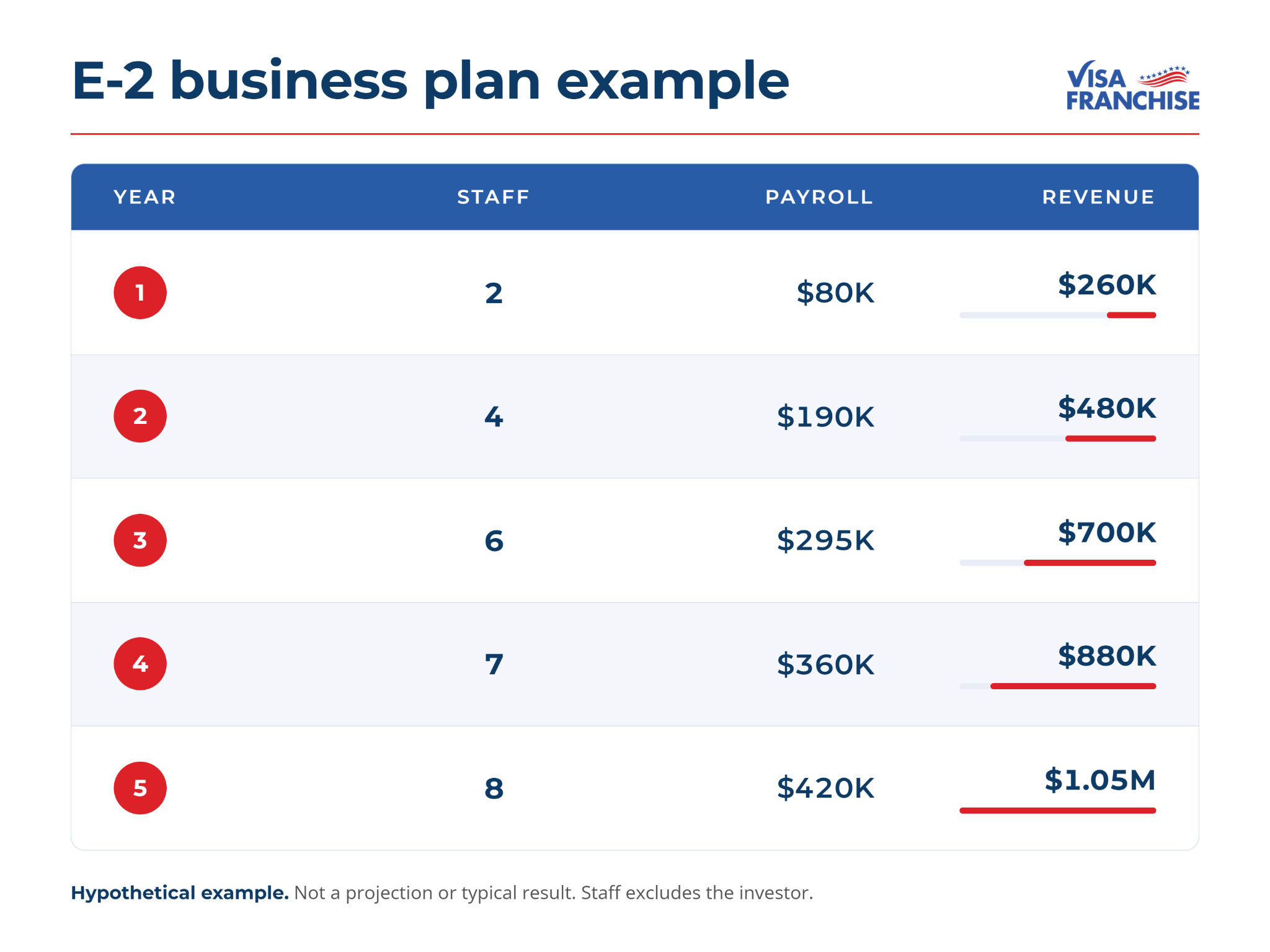
Below is a simplified, hypothetical example of what the hiring plan and five-year projections might look like for a home services franchise. The figures are illustrative only; they are not based on any real franchise or client, nor are they a forecast of results. They also do not indicate whether a plan would be approved.
In this example, the investor puts around USD 150 000 into a new franchise location and works full-time as general manager. For how investments break down by type of business, see our E-2 visa investment examples.
How much does an E-2 visa business plan cost?
The cost of an E-2 visa business plan varies greatly depending on who writes it. Prices vary widely on the market, ranging from low-cost templates and AI tools to freelance writers and specialised firms. Prices depend on the scope of the work, the writer’s E-2 experience, and the complexity of your business.
If you write the plan yourself, the only cost is your time, but you will have to conduct the market research and create the five-year financial model yourself. While a template or AI tool can provide a structure, the research and figures must still come from your business.
How long does it take to write an E-2 business plan?
From the initial conversation to the final version, the process typically takes several weeks because most of the time is spent gathering information and reviewing drafts rather than writing.
The work usually happens in four stages:
- Gathering information. This stage depends most on you. The writer will need details such as your signed or draft lease or franchise agreement, the company’s formation documents, your CV, investment figures, and quotes for equipment or build-outs. The more of this information you have ready, the faster the plan will progress.
- First draft. This will include research, the financial model and the written plan, and will usually take one to two weeks.
- Then comes the review and revisions stage. You will review the draft and your immigration attorney will check that it fits with the rest of the filing. Each round of changes adds a few days.
- Final updates. If figures change or your interview date moves, the plan may need to be updated before submission.
The process tends to be slowed down by the following: choosing the business or location while the plan is being written; figures that change midway through the process (such as a new lease amount); documents that need translating; and several rounds of attorney comments.
As the plan must match your evidence at the time of filing, you should ask your attorney when it should be finalized and work backwards from that date.
Do you need an E-2 business plan writer?
There is no rule that requires you to hire a professional. Whether you should hire one depends on your experience with financial projections, your knowledge of the U.S. market for your business, the complexity of your case and how much time you have.
Writing it yourself can work if you've built financial models before and know your industry and local market well. You know your business better than anyone, and you will need to explain the plan at your interview anyway. The challenge is time and focus: the plan has to answer the officer's questions, not an investor's, and every figure has to match your evidence.
Starting from a template or AI tool gives you a structure, not a plan. It can work as a first draft, especially if a professional or your attorney reviews it afterward, but the research and the numbers still have to come from your own business.
Hiring a writer usually makes sense if you are new to the U.S. market, have not built five-year projections before, have a more complex case (several partners or locations, or an existing business with a financial history) or are working to a tight deadline. Even then, you still provide the information and need to know the plan well.
What to look for in an E-2 business plan writer?
- Industry and local research. The writer should research your sector and the area where you will operate, not just national figures. Ask to see an anonymized sample.
- Knowledge of E-2 guidance. They should know the State Department's guidance for consular officers (9 FAM 402.9) and how plans are reviewed at a consulate compared with a change of status through USCIS.
- Consistency with your financial evidence. Projections should be built from your real figures (lease, quotes, the franchisor's FDD) and match your bank records. Ask whether you will receive the financial model in an editable file.
- Coordination with your attorney. A good writer works with your independent immigration attorney and revises the plan based on their comments. A writer is not a lawyer, so legal strategy stays with your attorney.
Be cautious with anyone who guarantees approval, quotes approval rates as a promise, offers to adjust figures so the business “qualifies”, or simply fills in a standard template. .
How Visa Franchise prepares your E-2 business plan
At Visa Franchise, the business plan is not a standalone document. Each plan is written for an immigration case and customized to the client’s business and the location where the application will be processed. The plan is built around the investment, including how much has been invested, where the funds came from, and how they have been used in the business.
The plan is prepared by the same company that helps you form your business, organize your source-of-funds documents, and choose a franchise brand, if applicable. This means the figures in the plan come from the same documents that support the rest of your case.
The process usually works like this:
- Intake call. Your Client Advisor reviews your business, investment, and timeline with you and sends you a form covering the information needed for the plan.
- Research. We will research your business and the local market. For a franchise, we use the franchisor’s Franchise Disclosure Document (FDD) and its materials. For an independent business, we base our research on the information you provide in the form. In both cases, we add industry and market data for your area.
- Financial model and first draft. We will build the five-year projections and hiring plan based on your actual investment figures and the projections you provide in the form. Salaries will be based on our research of each role in your market. We will write the plan within the agreed-upon timeframe once we have your information.
- Then, you and your attorney review it. First, you will review the draft to confirm that the content and projections accurately reflect your business. Then, the independent immigration attorney you hire will review it from an immigration standpoint. Both reviews are important, and we will revise the plan based on your and the attorney's feedback.
- Final version. Once the plan is approved, you will receive the final version in PDF format.
Common E-2 business plan mistakes
A good business idea can still come with a weak plan. Usually the problem is a figure the officer has no reason to believe. These six mistakes come up most often.
- Inflating the projections to impress. While it can be tempting to think that bigger numbers make a stronger case, revenue that triples in Year 2 with no explanation will be seen as wishful thinking rather than credible. Every increase should be backed up by a reason: more customers, a new location or added capacity, for example. If you cannot explain where the extra sales will come from, the figure is too high.
- A hiring plan that does not add up. Simply saying that the business “will create jobs” is not enough. You should list each position, including the start date and salary, and ensure that the projected revenue can actually cover the payroll costs. If the business will generate work for local suppliers or contractors, you can mention this as a complement to your own hiring, not a substitute.
- Generic market research. National industry figures, outdated data, and unsourced claims such as 'the market is growing fast' do not demonstrate that your business can succeed in its target location. Use recent, cited data for your local area and name your actual competitors.
- Figures that do not match your evidence. For example, if your business plan states that you invested one amount, but your bank records show a different amount, or if the rent in the projections differs from that stated in the signed lease, the officer will notice. Build the plan using your real documents and update it whenever a figure changes.
- A template that reads like a template. Officers see the same boilerplate structure and wording time and time again. A plan with generic text and standard staffing tables that do not include any details specific to your business suggests that little real planning went into it.
- Not knowing your own plan. If someone else writes your plan and you only skim through it, this will be evident at your interview. You should be able to explain your key figures, hiring timeline and marketing strategy in your own words.
Some of the most serious issues in E-2 cases are unrelated to the business plan, such as nationality, the size of the investment, and uncommitted funds. For more information on these issues, see our guide to E-2 visa requirements.
FAQ
Can I use a business plan template for my E-2 visa?
You can use a template as a starting point for the structure, but not as the finished plan. The market research, the hiring plan and the five-year figures have to come from your own business, and a plan that reads like a filled-in template can raise doubts about how much real planning went into it.
Can I use the franchisor's business plan?
Not as it is, but much of the franchisor’s information is useful. The franchise disclosure document (FDD) breaks down the initial investment and, in some cases, the financial performance of existing locations, which helps build realistic projections. Your E-2 plan, though, has to reflect your own location, territory, investment, hiring plan and role in the business, which a franchisor’s general material does not cover.
Does my E-2 business plan need 5-year projections?
For a new business, five-year projections are standard. The E-2 regulation (8 CFR 214.2(e)(15)) says a business’s capacity to do more than support the investor and family should generally be achievable within five years, and the projections are how a plan shows that path. If you are buying an existing business, the plan usually combines its financial history with projections going forward. Your attorney confirms what your case needs.
Does the business plan have to be in English?
In practice, yes. The US Citizenship and Immigration Services (USCIS) requires a full English translation, certified by the translator, for any foreign-language document submitted (8 CFR 103.2(b)(3)), and consulates set their own document requirements, so plans are usually prepared in English. If English is not your first language, it can be helpful to keep a version in your native language so that you are familiar with the contents of the plan before your interview. Your attorney can confirm the requirements for your consulate.
Visa Franchise is a business consulting firm, not a law firm, and does not provide legal advice. Immigration legal services are provided by independent, licensed immigration attorneys whom clients engage directly. Nothing here is legal advice or a guarantee of any immigration outcome. Eligibility and results depend on the specifics of each case and are assessed by the attorney.
Discover if you qualify to invest in a thriving U.S. franchise and secure your E-2 visa.
Check your eligibility
More Insights You Might Like
Explore related articles packed with expert advice, real stories, and practical tips to support your U.S. visa and relocation journey.


