
E-2 visa requirements 2027: investor and business checklist


The E-2 visa requirements for 2027 fall into two categories: those that apply to you as an investor and those that your U.S. business must fulfill. This checklist covers both groups, as well as the rules for key employees and family members.
Obtaining an E-2 visa is not just about meeting one major requirement. Consular officers and USCIS review each requirement individually, so a large investment does not compensate for unclear ownership or an untraceable source of funds.
This guide organizes the 2027 E-2 visa requirements by who has to meet them (the investor, the business, key employees, and family members) and explains what is usually reviewed for each requirement, based on federal regulations and the State Department's manual.
E-2 investor requirements
To qualify as an E-2 treaty investor, you must meet the six requirements set forth in federal regulations (8 CFR 214.2(e)) and the State Department's Foreign Affairs Manual (9 FAM 402.9).
Both consular officers and U.S. Citizenship and Immigration Services (USCIS) review each requirement separately, so a strong investment does not make up for weak proof of nationality or control. The table below summarizes what is usually reviewed for each requirement, and the following sections explain how each requirement works.
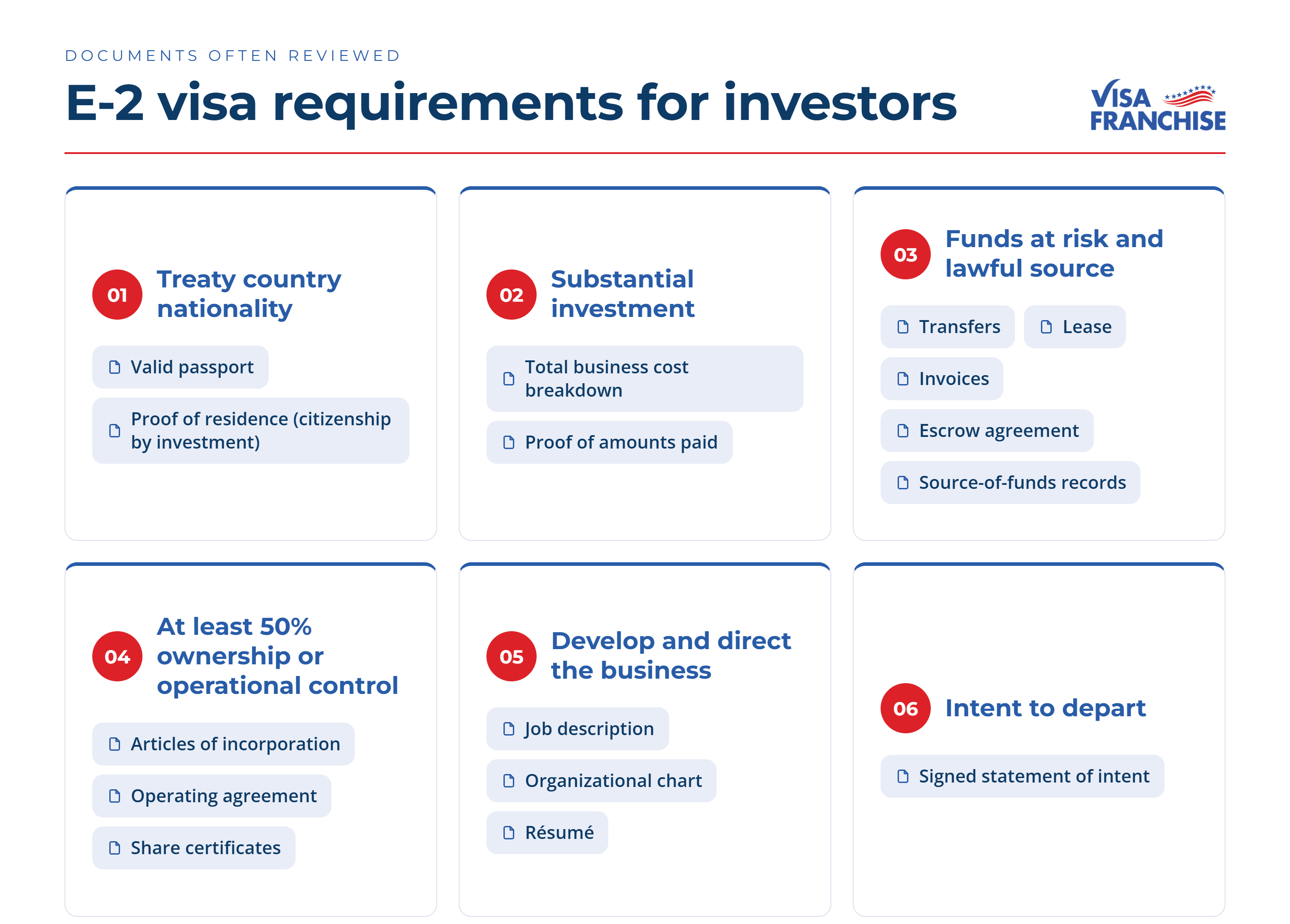
The independent immigration attorney handling the case decides which documents go into a specific application and whether they are enough.
Treaty country nationality
The E-2 visa is only available to nationals of countries that have a treaty of commerce and navigation (or an equivalent agreement) with the United States. This includes countries such as Canada, Australia and New Zealand. Your citizenship is what matters, not where you live or where you were born.
For example, an Indian citizen living in the United Kingdom cannot apply as a British national. However, a person born in India who later became a British citizen can apply with a British passport.
Two situations deserve attention:
- Dual citizens: A person with dual nationality can usually apply using the passport of the relevant treaty country. Whether this applies to your case is something that your attorney can confirm.
- Citizenship by investment: Since the James M. Inhofe National Defense Authorization Act for Fiscal Year 2023, individuals who obtained citizenship in a treaty country through a financial investment must have resided in that country for at least three years prior to applying for an E visa. This rule does not apply to citizenship obtained by birth, descent, or marriage.
The list of treaty countries changes over time, so check your country's current status on our E-2 treaty countries list before planning your investment.
Substantial investment
There is no minimum dollar amount for the E-2 visa. According to the regulations, however, the investment must be "substantial" in three ways: it must be in proportion to the total cost of buying or starting that type of business; it must be large enough to demonstrate your financial commitment; and it must be sufficient to make it likely that you can develop and direct it.
The State Department's manual describes this as an inverted sliding scale: The lower the total cost of the business, the higher the percentage of the cost you are expected to cover.
For a small service business, the investment usually needs to cover most of the costs. In a more expensive business, such as a franchise with a commercial location and equipment, a lower percentage can still be proportional.
This is why the same amount can be substantial for one business and insufficient for another. Although the regulations do not stipulate a minimum amount, our experience at Visa Franchise is that many of our E-2 clients have invested $100,000 or more.
This is a guideline, not a rule, and results vary from case to case. The important thing is how the amount relates to the cost of the business and how well the other requirements are met.
A larger investment does not guarantee approval. This is why the role of the independent immigration attorney is so important: they must assess whether the investment is substantial and define how it should be structured. To see how these numbers look in real businesses, check out our E-2 visa investment examples.
Funds at risk and lawful source
According to the regulations, an E-2 investment means placing your own capital at commercial risk with the intention of generating a profit. In practice, three conditions apply:
The money must be committed to the business. Funds that have been spent or are irrevocably obligated usually count, such as for equipment, inventory, prepaid rent, build-out, franchise fees, or business purchase costs. Money sitting in a personal or business bank account, waiting to be used, generally does not count.
It must be at risk and under your control. You must be able to lose part or all of it if the business fails. Loans secured by your personal assets may count, but loans secured by the business's assets generally do not, since the risk falls on the lender rather than you.
Its origin must be lawful and traceable. Applicants are usually expected to show the full path of the money, from its origin (savings, sale of property, inheritance, or business profits) to the U.S. business.
If you do not want to spend the money before knowing the outcome, one option mentioned in the regulations is to place the funds in an escrow account that is released only if the E-2 visa is approved. This option commits the money to the business while protecting it in case the application is denied.

At least 50% ownership or operational control
The regulations require you to demonstrate control of the business, either by owning at least 50% of it or by holding operational control through a managerial position or another corporate mechanism.
Most investors meet this requirement by owning at least 50%. Two cases are less obvious:
- Equal 50/50 partnerships. According to the State Department's manual, in a joint venture where two partners each own 50%, each partner has negative control, or the ability to block decisions, which can be sufficient.
- Less than 50%. A minority investor needs to document actual operational control, for example, through an operating agreement or a management role with real decision-making authority.
This requirement differs from the business's nationality; at least 50% of the company must be owned by nationals of the treaty country. Changes in ownership structure can affect the E-2 status of everyone in the company if that percentage drops, so it is important to keep ownership records up to date.
Develop and direct the business
The E-2 visa is not intended for passive investors. You come to the United States to run the business. In practice, this usually involves making decisions, hiring staff, managing operations, and determining the company’s direction. The attorney will assess how the legal standard applies to your role.
In practice, officers determine whether your role, background, and business structure align. A job description, an organizational chart showing where decisions are made, and a résumé consistent with the position can demonstrate this. A role focused mainly on routine operational tasks or a plan in which a hired manager runs the business while the investor stays away raises questions about this requirement.
Key employees who are not the investor, such as executives, supervisors, and staff with essential skills, have their own requirements.
Intent to depart
The E-2 visa is a nonimmigrant visa. Regulations require that you intend to leave the United States when your E-2 status ends, whether due to the closure of your business, its sale, or your cessation of operations.
This requirement is often confused with those of other visas. Unlike a tourist visa, the E-2 does not require you to maintain a residence or strong ties in your home country. According to the State Department's manual, an unequivocal statement of your intent to leave when your status ends is generally sufficient, unless an officer has specific reasons to doubt it.
According to the USCIS, E-2 status can be extended indefinitely, provided that the business continues to meet the necessary criteria. However, this does not lead directly to a green card. The regulations also state that an E application cannot be rejected just because an immigrant petition has been filed. If permanent residence is part of your plan, read E-2 Visa to Green Card and discuss the timing with an independent immigration attorney.
E-2 visa business requirements
These requirements apply to the company, not to you. According to the regulations (8 CFR 214.2(e)), the business must be genuine and operational and not merely marginal. It must also be at least 50% owned by nationals of a treaty country. There is no official list of 'E-2 approved' businesses or franchises; each business is evaluated on how it meets these requirements.
A real, operating business
The business must be an active, for-profit company that produces goods or services, and it must have the necessary licenses and permits to operate. Passive investments, such as land or property held for resale or rental, stocks, a stake in an investment fund or a silent minority share in another company, do not qualify.
If the business is new, it cannot exist only on paper. Officers will usually look for signs that the business is ready to operate, such as a signed lease, purchased equipment or a franchise agreement. If you are buying an existing business, its revenue, payroll and tax returns can be reviewed instead of relying solely on projections.
A business that is not marginal
According to the regulations, a marginal business is one that cannot generate a decent living for the investor and their family, either now or in the future. While a new business does not need to have this capacity from the outset, it should generally achieve it within five years of commencing normal operations.
Although the E-2 visa does not stipulate a minimum number of jobs, having a realistic hiring plan in place is one of the most effective ways of showing that your business will have an impact beyond your household.
Our E-2 visa business plan guide explains how to present this, and you can explore businesses that qualify for the E-2 visa.
At least 50% owned by treaty nationals
At least 50% of the company must be owned by nationals of the treaty country, as determined by tracing it back to the individuals who ultimately own it. Partners who are U.S. citizens or green card holders are not included in that 50%.
If ownership changes and treaty nationals end up owning less than 50%, this could affect the E-2 status of the investor and the company's E-2 employees.
Requirements for E-2 employees
The E-2 visa is not only for investors. A qualifying E-2 company can also bring key employees to the United States. These employees do not invest money or present their own business plan, but they must meet the following four requirements set out in the regulations (8 CFR 214.2(e)(3), (17) and (18)):
- They must have the same nationality as the company. The employee must have the nationality of the treaty country, and the company must be at least 50% owned by nationals of that country.
- A qualifying role. The position must be executive or supervisory, or require skills that are essential to the business.
- Work only for that company. E-2 employee status is tied to the E-2 business and does not allow you to work for another employer.
- Intent to depart when the E-2 status ends, the same as the investor.
Executive or supervisory positions
The role must provide the employee with genuine control over the business, or a substantial portion of it. The main function must be supervision, so a job that is mostly routine with some oversight of junior staff generally does not qualify. Officers consider the job title, duties, salary, and the employee’s experience.
Employees with essential skills
These employees possess the skills that the business requires and which are hard to find in the US labour market. Officers typically review the level of specialisation required for the role, as well as the necessary experience and salary. Workers needed to start operations or train staff may qualify, but only for a limited time.
The employee’s spouse and unmarried children under 21 follow the same rules as the investor’s family.
E-2: Requirements for spouses and children
The investor’s family can come to the United States with E-2 dependent status. According to the regulations (8 CFR 214.2(e)(4)), this only applies to spouses and unmarried children under the age of 21. Other relatives, such as parents, siblings or adult children, do not qualify as dependants.
Who counts as a spouse or child?
- Spouse: The marriage must be legally valid in the place where it took place, including same-sex marriages. Civil partnerships and domestic unions generally do not qualify.
- Children: They must be unmarried and under 21. This includes biological and legally adopted children, as well as stepchildren, provided that the marriage took place before the child turned 18.
Dependents do not need to have the investor’s nationality. For instance, a Spanish investor’s Venezuelan spouse can receive E-2 dependent status. The treaty nationality requirement only applies to the investor and the company.
What is new for E-2 requirements in 2027
While the core E-2 requirements remain unchanged, several new official rules now affect where and how you apply. These are the rules that will be in force from 2027 onwards.
In-person interviews for almost everyone
Since 1 October 2025, all non-immigrant visa applicants, including those aged under 14 or over 79, have generally been required to attend an in-person interview with a consular officer.
Apply in your country of nationality or residence
Since September 6, 2025, the State Department has directed non-immigrant visa applicants to apply at a U.S. embassy or consulate in their country of citizenship or residence. If they apply in a third country, they may face denial or delays. If you are applying based on residence, you must be able to prove it.
Travel restrictions for certain nationalities
Proclamation 10998 took effect on January 1, 2026. For nationals of countries subject to full suspension, consular officers ceased issuing all immigrant and non-immigrant visas, including the E-2. Two such countries are Iran and the Republic of the Congo. Other treaty countries, such as Senegal and Togo, face partial restrictions that do not suspend E visas. However, the proclamation directs consular officers to reduce the validity of other non-immigrant visas to the extent permitted by law. This list is subject to periodic government review, so please refer to the current guidance issued by the US Department of State for your nationality.
English proficiency for commercial drivers
According to the United States Citizenship and Immigration Services (USCIS), E-2 petitions for jobs that require operating a commercial motor vehicle must include evidence that the applicant meets the English proficiency standard. This can be demonstrated through a standardised test or a signed statement. This mainly affects businesses in the transportation and logistics sector.
Recent rules still worth knowing:
- Citizenship by investment. Under the NDAA for fiscal year 2023, people who became citizens of a treaty country through investment must have lived there for at least three years before applying.
- Portugal. Portuguese nationals have been eligible for the E-2 since March 2024.
FAQ
How much money do I need?
There is no minimum amount, but the investment must be substantial in proportion to the total cost of the business. The right figure therefore depends on the business you choose. See real numbers in our E-2 visa investment examples.
How long does it take?
The processing time varies depending on the route. For applications made abroad, it depends on the consulate and its interview availability. For applications made inside the United States, USCIS processes the change of status with optional premium processing. We compare both options in our guide to E-2 visa processing times.
Can it lead to a green card?
Not directly, since the E-2 is a non-immigrant visa. However, some E-2 investors later pursue permanent residence through other categories, such as the EB-5 or EB-2 NIW. The most suitable option for each case is assessed by an independent immigration attorney. You can find out more in E-2 Visa to Green Card.
What are the E-1 requirements?
The E-1 (Treaty Trader) visa, as set out in the regulations, is intended for nationals of treaty countries who conduct substantial trade with the United States, with more than half of their business's international trade taking place with the U.S. The list of eligible countries differs from that of the E-2 visa. Please refer to the E-1 visa requirements for more information.
Visa Franchise is a business consulting firm, not a law firm, and does not provide legal advice. Immigration legal services are provided by independent, licensed immigration attorneys whom clients engage directly. Nothing here is legal advice or a guarantee of any immigration outcome. Eligibility and results depend on the specifics of each case and are assessed by the attorney.
Discover if you qualify to invest in a thriving U.S. franchise and secure your E-2 visa.
Check your eligibility
More Insights You Might Like
Explore related articles packed with expert advice, real stories, and practical tips to support your U.S. visa and relocation journey.


